
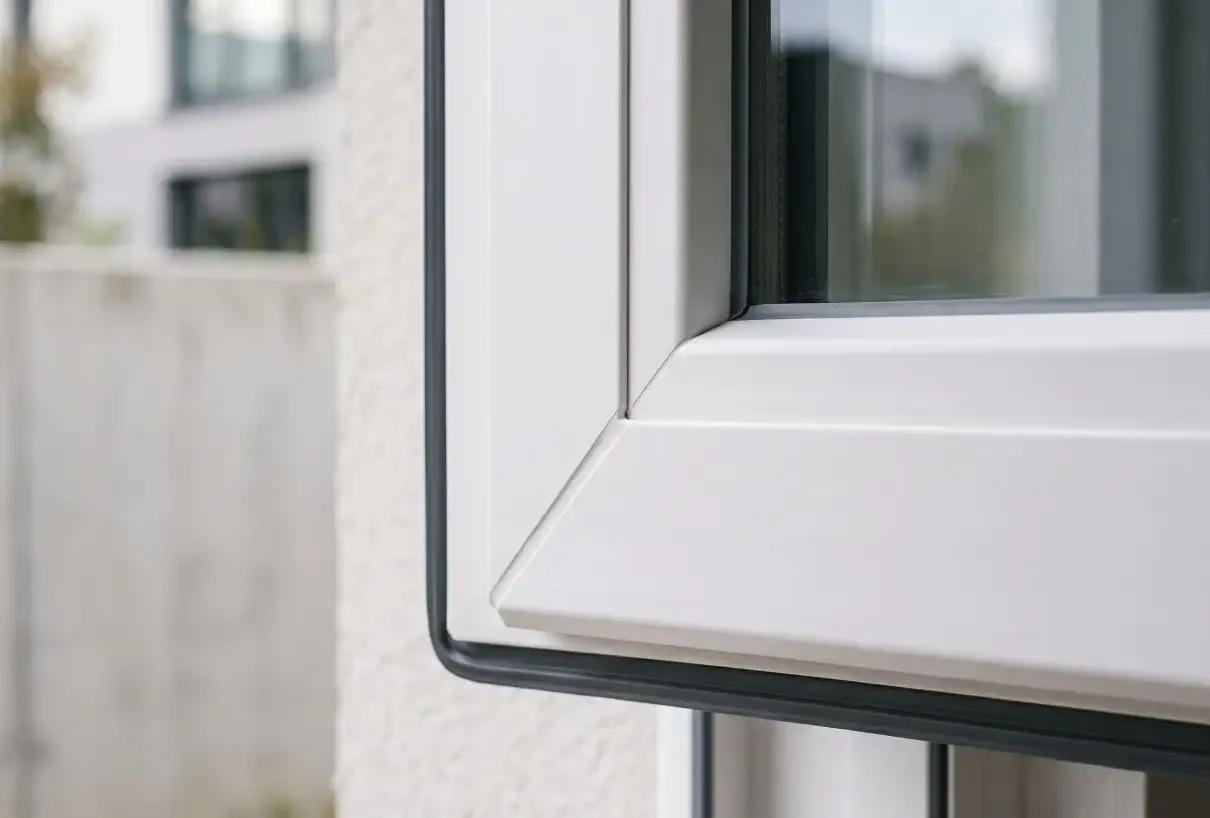
Call a uPVC window frame “low-maintenance plastic” and the description undersells what’s actually holding it together. Cut into a uPVC profile and, in most sizes, there’s steel inside it — a reinforcing insert doing a job the plastic on its own can’t. That division of labour, plus a hollow, multi-chambered profile shape and a specific way the corners are put together, explains uPVC’s better-known properties: why it resists rot for a different reason than either timber or aluminium manage it, why it insulates without any added engineering, why its colour is fixed for the life of the frame, and why it’s built around sliding and folding doors rather than the full range timber and aluminium cover. Each of those traces back to what the material and its construction are actually doing, not to a single blanket property called “plastic.”
What “uPVC” Actually Is, and Why It Doesn’t Rot
uPVC stands for unplasticised polyvinyl chloride — the word that matters is “unplasticised.” Ordinary PVC can be made flexible by blending in plasticiser compounds, which is how the same base polymer ends up as soft tubing, cable insulation, or synthetic leather. Leave the plasticiser out and the same polymer sets rigid, which is the form used for window and door profiles, structural pipe, and cladding — anywhere the material needs to hold its shape rather than flex.
That rigidity matters less for rot resistance than the chemistry underneath it does. Timber rots because it’s an organic material — wood is largely cellulose and lignin, and the fungi that cause decay feed on exactly those compounds once moisture and warmth give them the conditions to grow. Steel rusts because iron reacts with oxygen in a reaction that, unlike aluminium’s, never seals itself off. PVC offers neither a food source nor a metal lattice to oxidise. It’s a synthetic polymer, with no cellulose for fungi to break down and no free electrons for oxygen to react with, so the two decay mechanisms that account for almost every timber or steel failure simply have nothing to start with in uPVC. That’s a different kind of resistance from aluminium’s self-sealing oxide layer or timber’s maintained finish — it isn’t a protective mechanism working continuously, it’s an absence of the reaction pathway both of those other mechanisms exist to manage. In practice, a quality uPVC frame’s service life is commonly quoted in the 20- to 35-year range, long enough that the reinforcement and finish decisions covered below end up mattering more to how it performs over that life than the base polymer’s resistance to rot does on its own.
That doesn’t make uPVC indifferent to weather altogether. Ultraviolet light still acts on the polymer’s surface over enough years, breaking down its molecular structure the slow way UV breaks down any exposed plastic — a process that shows up as chalking, fading, or a slight loss of surface gloss long before it affects the frame’s structural integrity. It’s a far slower process than timber’s UV response, and it’s also the reason the finish sitting on top of the profile matters.
A Hollow, Multi-Chambered Profile With Steel Where It Counts
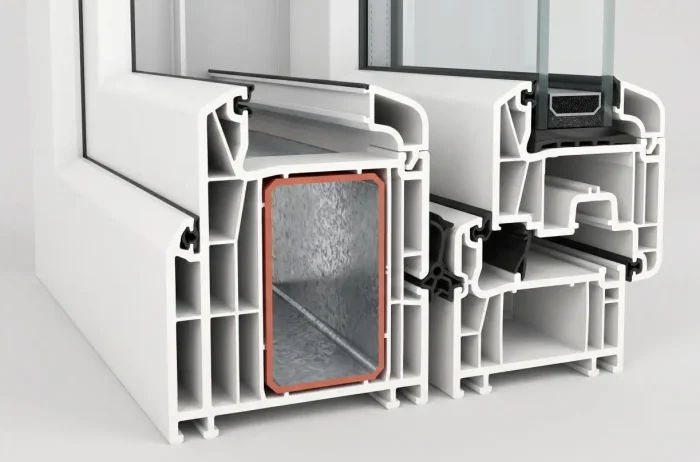
A uPVC profile isn’t a solid bar the way a timber section is. Like aluminium, it’s extruded — but into a hollow cross-section with several internal walls dividing it into separate chambers, typically somewhere between three and six, rather than one open cavity. A finished profile usually runs 60mm to 80mm deep to fit all of that in. Those internal walls do real structural work: they stiffen the profile against bending without adding the mass a solid section would need to reach the same stiffness, which is part of why uPVC is the lightest of the common frame materials to handle and install.
The chambers do a second job at the same time. Air trapped inside a small, enclosed space is a poor conductor of heat — roughly seven times less conductive than the PVC walls around it, which are themselves already a modest conductor next to a metal like aluminium. Stacking several sealed air pockets one behind another inside the profile adds insulating value the same way double glazing adds it over a single pane: each boundary the heat has to cross slows it down further. That’s why a uPVC frame doesn’t need a thermal break to reach reasonable insulation performance — the chamber design is doing, structurally, what that break does for aluminium by interrupting a solid conductive path.
None of that solves every structural question on its own, though. PVC alone — even shaped into a stiffened, chambered profile — isn’t rigid enough to reliably carry a full-size door, especially once a multi-point locking system and years of daily opening and closing are factored in. That’s where steel comes in: a galvanised steel box-section, inserted into the load-bearing chambers of the profile at the factory, wherever the specific door or window size demands the extra stiffness. The plastic is doing the weathering and insulating work; the steel, hidden inside it, is doing the structural work a door’s size and hardware actually need. Neither part is standing in for the other — it’s a deliberate division of labour built into the same extrusion.
Steel is the standard choice for that insert, not aluminium — worth pausing on, since aluminium is usually the material praised for doing more structural work per kilogram than almost anything else it gets compared to. That reputation comes with a condition attached: it holds when the material is free to be shaped into an optimised hollow section, walls positioned exactly where the load path runs and removed everywhere it isn’t. A reinforcement insert doesn’t get that freedom — it has to fit whatever chamber the uPVC extrusion already left for it, sized around the plastic profile rather than around the reinforcement itself, so it ends up a plain rectangular or C-shaped box rather than a purpose-optimised one. Compared as plain shapes rather than optimised ones, steel is simply stiffer: its resistance to bending per unit of cross-section runs to roughly three times aluminium’s, so a thinner steel box reaches the stiffness a bulkier aluminium one would need to match inside the same fixed space. The strength-to-weight advantage that defines aluminium as a frame material specifically depends on a shape freedom this particular job doesn’t offer.
The manufacturing route reinforces the same choice. A steel insert is typically roll-formed — flat galvanised strip bent into a box section on a fast, low-tooling line — rather than extruded, which suits a component that’s hidden, generic, and produced in dozens of length and size variants rather than shown off as the finished product. Aluminium reinforcement would call for the same extrusion process used on a visible frame, worthwhile when the part is what’s being sold, less so for a filler piece no one ever sees. And because the insert sits fully enclosed inside a sealed uPVC chamber, away from moisture and UV either way, steel’s usual weak point — corrosion — isn’t really in play; a galvanised coating covers what little risk remains.
Why the Corners Are Welded, Not Joined
How the frame goes together at the corners matters as much as what the profile is made of. A uPVC frame’s corners are fusion-welded: the cut ends of two profile lengths are heated until the material starts to melt, then pressed together under pressure so they fuse into one continuous piece as they cool. A small bead of melted material squeezes out along the joint as that happens, and it gets trimmed and cleaned off once the weld has set — the corner on a finished frame is meant to look seamless, even though it was a melt a moment before. That’s a different joining method from a mechanically fixed corner — screwed, crimped, or otherwise held together as two separate pieces meeting at an angle — and it produces a joint that’s airtight and, along the plane the frame sits in, very strong.
That strength shows up differently depending on how a door actually moves. A sliding or folding panel travels along a track, carrying its own weight on rollers rather than asking the frame around it to carry that weight — the corner joint mostly just needs to hold its shape while the panel does the moving. A hinged or pivot door works the opposite way: its full weight cantilevers off one edge every time it swings, and that load twists — racks — the frame at the corner diagonally opposite the hinge with every open-and-close cycle, for as long as the door is in service. A mechanically fixed corner can be engineered with some give to absorb that racking over time; a fused joint, being one continuous piece rather than two parts held together, doesn’t have the same separate movement to give. That load profile is a genuine reason sliding and folding configurations suit a fusion-welded frame particularly well, and it’s part of why the heaviest, most repeatedly stressed door configurations — hinged, pivot, full stacking panels — tend to go to materials built around carrying that kind of cyclic racking load instead.
Colour, Heat, and the One Point That Takes the Strain
Heat adds a second load to that same corner. Rigid PVC expands and contracts with temperature at roughly two to three times the rate aluminium does for the same change in degrees — its coefficient of thermal expansion sits somewhere around 50 to 70 millionths per degree, against aluminium’s roughly 23 — and a dark-coloured frame in direct sun reaches a noticeably higher surface temperature than a light one, enough to expand the profile measurably over the course of a day.
A mechanically fixed corner can be specified with some allowance for that movement built in. A fusion-welded corner, again, is one continuous piece with nowhere for that expansion to go except through the joint itself, so repeated daily expansion and contraction concentrates its stress at that exact point rather than spreading it elsewhere in the frame. That’s the real mechanism behind a detail that often gets stated as a flat rule without the reasoning behind it: darker uPVC colour options are typically more restricted, or specified with additional reinforcement, than lighter ones. It isn’t the colour itself doing anything — it’s the heat that colour absorbs, acting on the one joint in the frame that has to take it head-on.
A Finish That’s Decided Before the Frame Leaves the Factory
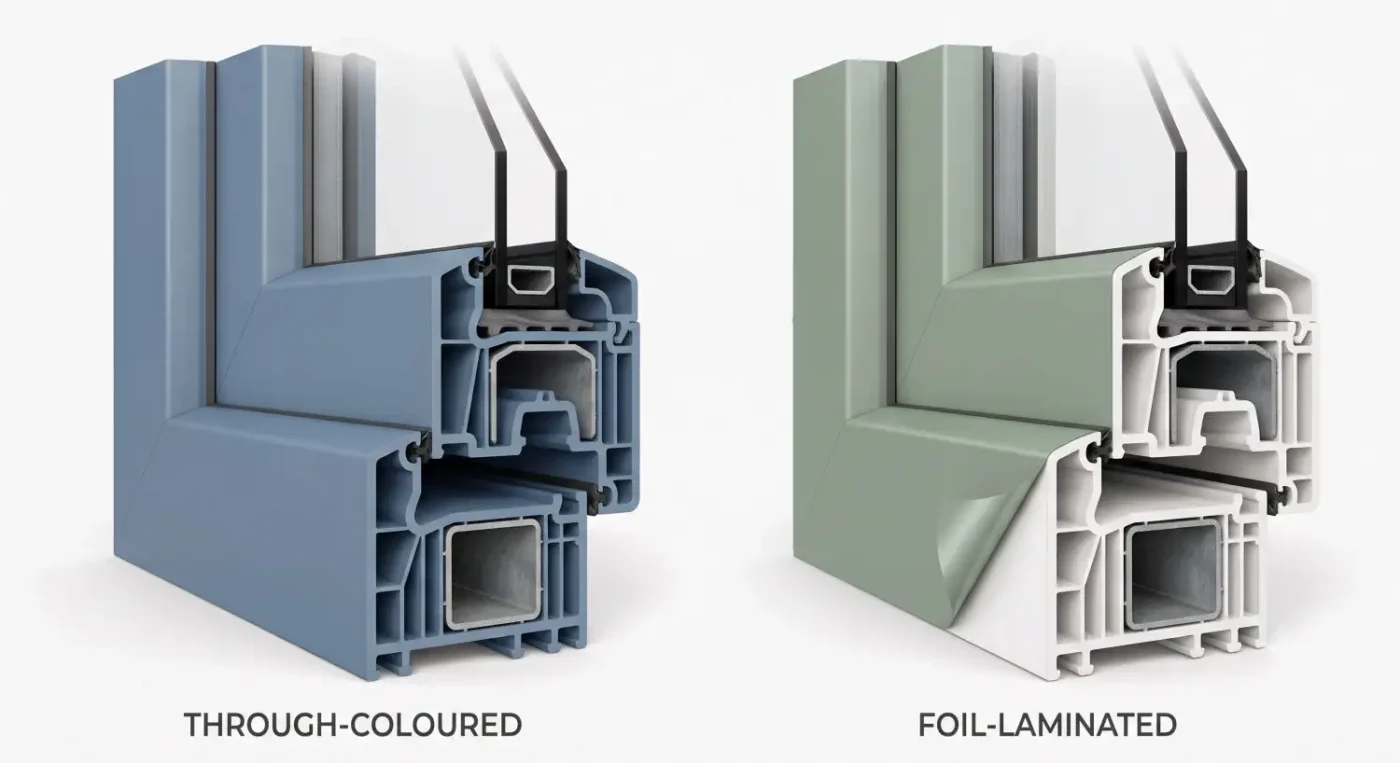
Colour on a uPVC frame is set one of two ways, and neither is a coating applied afterward the way paint or powder coat is. A through-coloured profile has pigment mixed directly into the PVC compound before it’s extruded, so the colour runs through the material rather than sitting on its surface. A foil-laminated profile takes a white or coloured base extrusion and heat-fuses a UV-stabilised decorative film onto it — still applied at the factory, still bonded rather than painted, just a different route to the same result. Between the two, the colour range available in uPVC has grown well past the plain white most people still picture, into foil-laminated woodgrain finishes and darker tones as manufacturing has matured.
Either way, there’s no separate coating layer sitting on top of the substrate the way there is with a painted timber surface or a powder-coated aluminium one. That has a direct practical consequence: there’s nothing to sand back and recoat if the surface is damaged. A deep scratch or an impact mark on a through-coloured profile exposes more of the same-coloured material underneath it; on a foil-laminated one, it can go through the film to the substrate beneath. Either way, the fix is replacing that section, not restoring a surface, because there was never a separate surface layer to restore in the first place. That’s the direct trade-off for not needing a recoat schedule at all: the same finish that lasts without upkeep is also the one that can’t be touched up if it’s damaged.
None of uPVC’s better-known properties come from the plastic alone. Its rot resistance comes from a chemistry that gives moisture and fungus nothing to act on; its insulation comes from air trapped in a chambered profile; its structural capacity comes from steel hidden inside that profile, not the PVC itself; and its fixed finish and door-type range both trace back to how the corners are put together and what heat does to that specific joint. Matching a uPVC frame to the right opening — the size, the colour, the configuration — depends on those specifics rather than a general sense that “uPVC is low-maintenance,” which is also why sizing and colour are typically settled through a proper measure-up and quote rather than off a shelf, standard practice for custom door and window work generally and no different for uPVC specifically.