
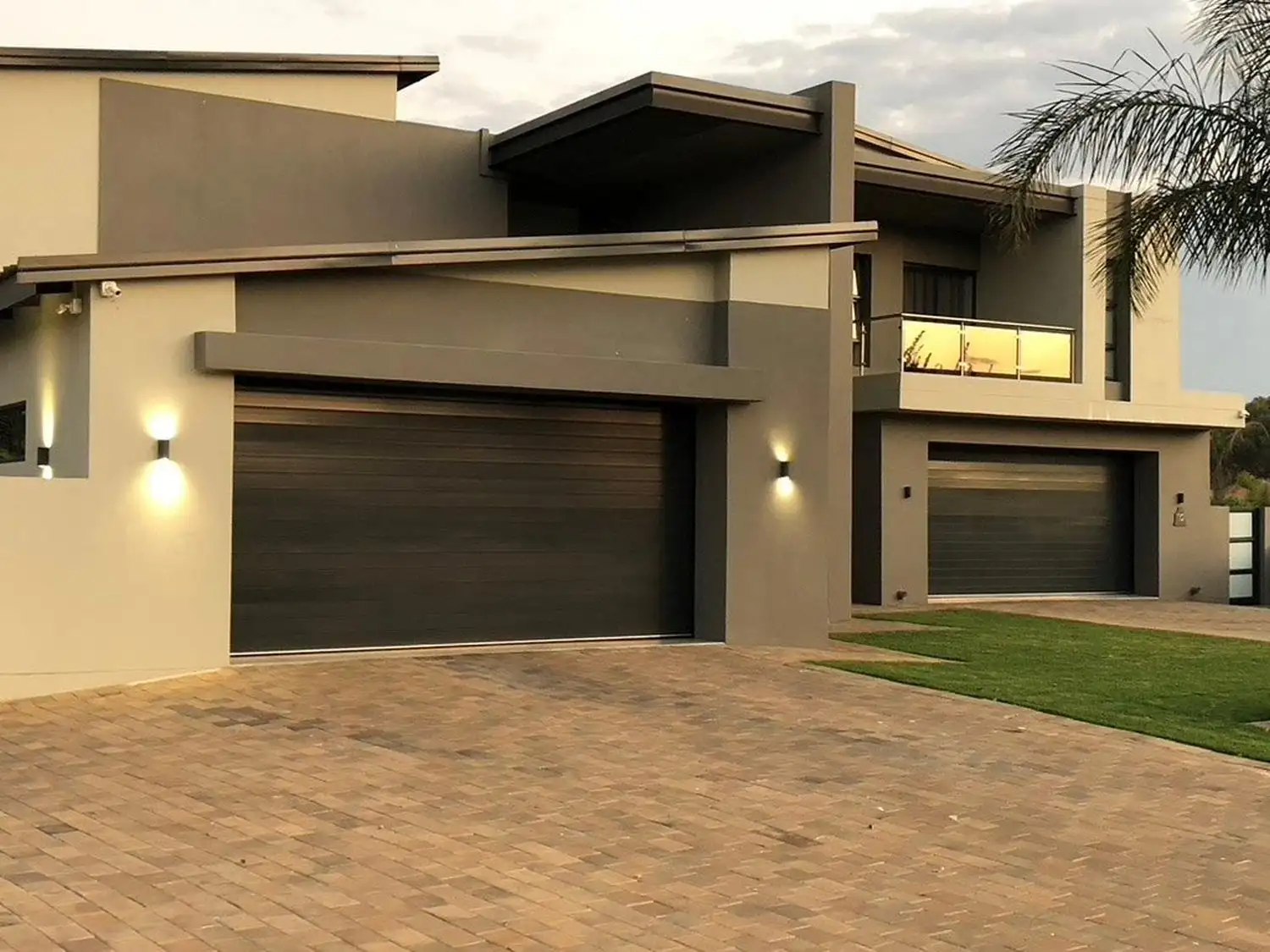
Garage doors are one of the most-used moving parts of a home. The average household opens and closes their garage door three to five times a day. Over ten years, that adds up to more than ten thousand cycles. A poor choice shows quickly — and replacing a garage door is not a small expense.
This guide covers everything worth knowing before buying: materials, mechanisms, sizing, what drives cost, and what to think about for South African conditions specifically.
What Type of Garage Door Do You Actually Need?
Before materials and aesthetics, the mechanism matters. It determines how the door moves, how much ceiling space it uses, whether it suits your driveway, and how much maintenance it will need over time.
Sectional Garage Doors
Sectional doors open vertically and travel along a track system that takes the door panels up along the ceiling. Because they move straight up rather than swinging outward, they require no clearance in front of the garage — a practical advantage for shorter driveways and properties close to the street.
They offer a good seal against weather and dust, which matters in areas prone to wind or the heavy summer thunderstorms common across Gauteng and the broader Highveld. Most sectional doors are motorised by default, though manual operation is possible.
Sectional doors are the most common residential garage door type in South Africa and are available in steel, aluminium, timber, and timber-look finishes.
Roll-Up (Roller) Garage Doors
Roller doors are made up of narrow horizontal slats that coil around a drum mounted above the opening. They take up minimal ceiling space — useful in garages used for storage or workshops — and tend to be compact and relatively fast to operate.
They are most commonly finished in steel or aluminium, used across residential and light commercial buildings in South Africa, and typically supplied by specialist roller-door manufacturers rather than by Van Acht. Insulation and acoustic performance are generally lower than sectional doors, though insulated roller door options exist.
Tip-Up (Tilt) Garage Doors
Tip-up doors are a single solid panel that pivots outward and upward when opened. They require clearance in front of the garage as the bottom of the door swings out. They tend to be simpler and less expensive than sectional doors and are a common choice for single garages in older South African homes.
Timber tip-up doors are particularly popular for their traditional appearance. The mechanism is straightforward, which means lower maintenance requirements over time — though the outward swing can be an inconvenience on tighter driveways.
Side-Hinged Garage Doors
Side-hinged doors open outward like a pair of large doors — the traditional farmhouse style. They require no ceiling track or motorisation, which makes them easy to maintain and access manually. They are well suited to wider garage openings and work particularly well in timber.
The main limitation is driveway space — both leaves need clear room to swing out fully. For garages used as utility spaces or workshops, where the door may remain open for extended periods, this style works well.
Garage Door Materials — What Each One Does Well
Material choice affects appearance, maintenance, lifespan, insulation, and cost. There is no universally correct answer — the best material depends on the specific property, the local environment, and how the garage is used.
Timber
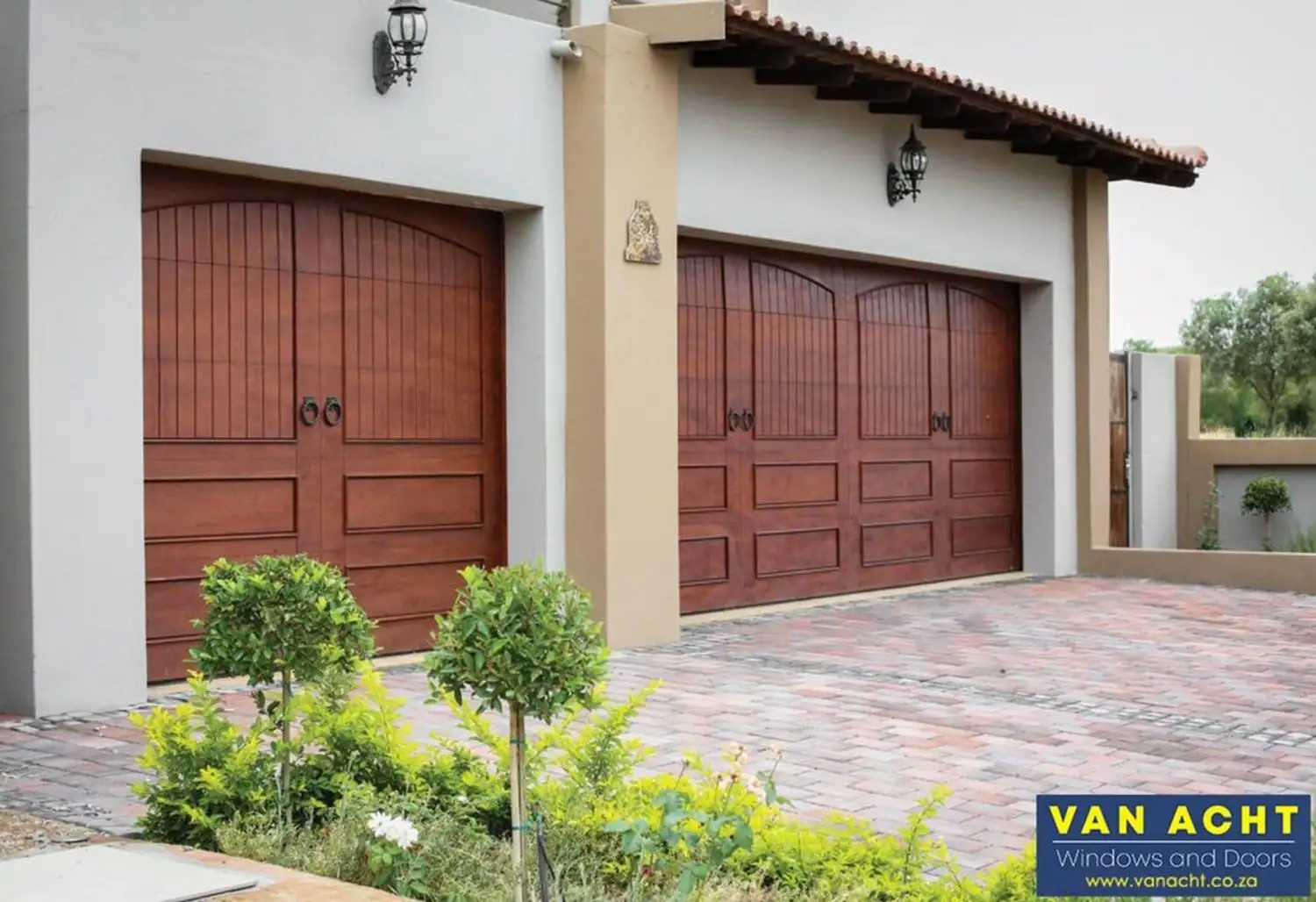
Timber garage doors are valued for their appearance and their adaptability. They can be painted, stained, or oiled to suit almost any architectural style, and they take custom sizes and detailing well. In South Africa, timber is a well-established material for both traditional and contemporary residential garage doors.
Properly treated timber is one of the better material choices for coastal properties — a fact that surprises many buyers. Tropical hardwoods like Meranti have a natural resistance to moisture, rot, and warping that holds up well in high-humidity environments. The right finish makes an equally significant difference — a penetrating treatment that bonds with the wood performs far longer in coastal conditions than a standard surface varnish. Engineered timber ranges built around UV stability and rot immunity, such as the Versa Wood range, are worth considering for areas like the Western Cape and KwaZulu-Natal coast. When the species and treatment are right, timber outlasts most alternatives.
Inland, the demands shift toward UV stability and flexibility to handle wide temperature swings. A correctly finished timber door on the Highveld will last decades with a consistent maintenance schedule. Timber also offers good natural insulation compared to steel or aluminium — worth considering for attached garages or garages used as habitable spaces.
Steel
Steel is the dominant material for sectional garage doors in South Africa. It is durable, relatively affordable, widely available, and requires minimal maintenance when properly coated. Modern steel doors are available with wood-effect finishes that credibly mimic timber from a distance.
The weakness of steel is corrosion in coastal environments. A standard galvanised and powder-coated steel door will hold up well inland, but within a few kilometres of the sea, marine-grade coatings or alternative materials should be prioritised. Steel is also susceptible to denting from impact, which is relevant in high-traffic family garages.
Insulated steel panels — where a foam core is sandwiched between two steel skins — offer significantly improved thermal and acoustic performance and are worth specifying for any garage attached to a living space.
Aluminium
Aluminium does not rust, which makes it a natural choice for coastal properties. It is lighter than steel, which reduces wear on motors and hardware over time. Aluminium also suits modern architectural styles well — clean lines, large glazed panels, and minimalist finishes are all achievable in this material.
The limitations are cost and rigidity. Aluminium is generally more expensive than steel for comparable sizing, and thinner aluminium panels can be prone to warping under significant temperature variation. Quality of the extrusion and the framing system matters here — heavier section aluminium performs well over time.
Fibreglass and GRP
Fibreglass and glass-reinforced plastic doors are lightweight, resistant to rust and corrosion, and can be moulded into timber-look textures. They are a reasonable option for coastal properties where steel is a poor fit and timber maintenance is undesirable.
They tend to be less common in South Africa and the range of styles is more limited than steel or timber. UV exposure over time can cause surface fading or chalking, though this varies by product quality.
Sizing — What to Measure Before You Buy
Garage door sizing in South Africa follows reasonably consistent conventions, but properties — particularly older ones — vary significantly. If you prefer to measure yourself before approaching a supplier, the key dimensions are straightforward to take. When buying from Van Acht, they will measure on-site before manufacturing — so no dimension goes to production without being confirmed in person.
Standard Sizes
Common South African garage door widths:
- Single garage: typically 2.4 m wide
- Double garage: typically 4.8 m to 5.0 m wide, sometimes 5.4 m
- Height: most residential openings are 2.1 m, though 2.4 m is increasingly common in newer builds
These are opening sizes — the door itself is typically manufactured slightly larger to cover the frame and provide a weather seal. Confirm with your supplier exactly which dimension they quote to: the opening size or the door size.
What to Measure On-Site
- Clear opening width: measure at the widest point
- Clear opening height: floor to the underside of the lintel
- Headroom: the distance from the top of the opening to the ceiling — critical for sectional doors, which need 200–300 mm of headroom minimum
- Side room: clearance either side of the opening for track and hardware mounting
- Depth of garage: for sectional doors, the panel stack at the top of the track needs space — typically 400–500 mm depending on panel thickness
Non-standard openings are common in older South African homes, particularly in Cape Dutch, Victorian, and mid-century properties. Most reputable suppliers manufacture to custom sizes — expect a lead time and a price premium for non-standard dimensions.

South African Conditions — What Changes the Equation
South Africa’s climate and built environment introduce considerations that do not always appear in international buying guides.
Coastal vs Inland Properties
Salt air accelerates corrosion on steel and poorly protected hardware. Within approximately 5 km of the coast — and closer in exposed or high-wind locations — aluminium, timber, fibreglass, or marine-grade steel should be prioritised. The West Coast in particular is one of the harshest environments for metal hardware in South Africa, with strong onshore winds carrying salt further inland than in more sheltered coastal areas like parts of the Garden Route. Hardware including springs, tracks, and hinges should also be specified in stainless steel or corrosion-resistant finishes in all coastal locations. Standard galvanised hardware will deteriorate faster than expected anywhere near the sea.
Highveld Heat and Summer Storms
In cities like Johannesburg and Pretoria, the combination of intense UV exposure, high afternoon temperatures, and regular late summer thunderstorms creates specific demands. Timber requires a quality UV-stable finish applied correctly and maintained on a regular schedule. Dark-coloured steel doors absorb heat significantly, which can affect insulated panels and motorised mechanisms over time. A lighter finish or a timber door with good insulation properties is worth considering for attached garages that back onto living spaces.
Load Shedding and Motorised Doors
South Africa’s load shedding reality makes battery backup on garage door motors a practical necessity rather than an optional extra. Most reputable motor brands offer battery backup units, and some motors include it as standard. A garage door that cannot open during a power cut is both a security and access problem.
Manual release mechanisms on motorised doors are also important — not just for power failures, but for motor failures. Any motorised door should have a properly functioning manual override that household members know how to use.
Security
Garage security in South Africa warrants more attention than the door mechanism alone. The door itself should be solid and well-fitted — gaps at the sides or bottom are both a security and weather vulnerability. Motorised doors should use rolling-code remote technology, which changes the access code with each use and is significantly harder to clone than older fixed-code systems.
Where the garage connects to the interior of the house, the internal door should be treated with the same security standard as an exterior entrance door. A weak internal door undermines even the best garage door.
What Drives Cost
Garage door pricing in South Africa varies considerably. Understanding the main cost drivers makes it easier to evaluate quotes and decide where to spend and where to save.
- Material: Timber and aluminium are generally more expensive than steel. Custom timber work in hardwoods significantly increases cost.
- Size: Larger doors require more material and heavier hardware. Double doors cost more than singles, and non-standard sizes carry a custom manufacturing premium.
- Mechanism: Sectional doors cost more than tilt or roller doors at equivalent sizes. Motorisation adds cost, and battery backup adds further.
- Insulation: Insulated panels and doors cost more but deliver energy and acoustic benefits that compound over time, particularly in attached garages.
- Glazing: Windows or full glass panels in a garage door increase cost substantially but change the character of the door and the light inside the garage significantly.
- Hardware quality: Springs, hinges, tracks, and rollers vary in quality and lifespan. Cheap hardware on an expensive door is a false economy — hardware failure is the most common source of garage door problems.
Installation cost is separate from the door cost and varies by region and the complexity of the job. Some suppliers include installation in their pricing; others quote supply only. Clarify this upfront.
Motorisation — What to Know Before Specifying a Motor
Most South African homeowners motorise their garage doors. The choice of motor matters more than many buyers realise — a door can outlast several motors, and a poorly chosen or installed motor is a recurring problem.
- Match motor to door weight: An underpowered motor on a heavy timber door will wear out faster and operate unreliably. Motor specifications include maximum door weight — take this seriously.
- Cycle rating: Motors are rated by cycles per day. A household using the garage frequently should specify a higher-cycle motor.
- Battery backup: Essential in South Africa. Some motors include it as standard; others require it to be added separately.
- Noise level: Belt-drive motors are quieter than chain-drive motors — relevant for garages adjacent to bedrooms.
- Smart home integration: An increasing number of motors support Wi-Fi connectivity, allowing remote operation and status monitoring via smartphone.
Sourcing and matching a garage door motor is not something every buyer wants to take on. For those who would rather not, Van Acht stocks Centurion motors in two configurations, ready to install alongside the door. The single-door version comes with a physical remote and standard battery backup, so it keeps operating through load shedding. The double-door version adds Wi-Fi and app control — checking or operating the door from a phone — along with a belt drive that runs quieter than the single-door version, though its battery backup is sold separately rather than built in. Both include automatic obstruction detection as standard.
Maintenance — What Keeps a Garage Door Running Well
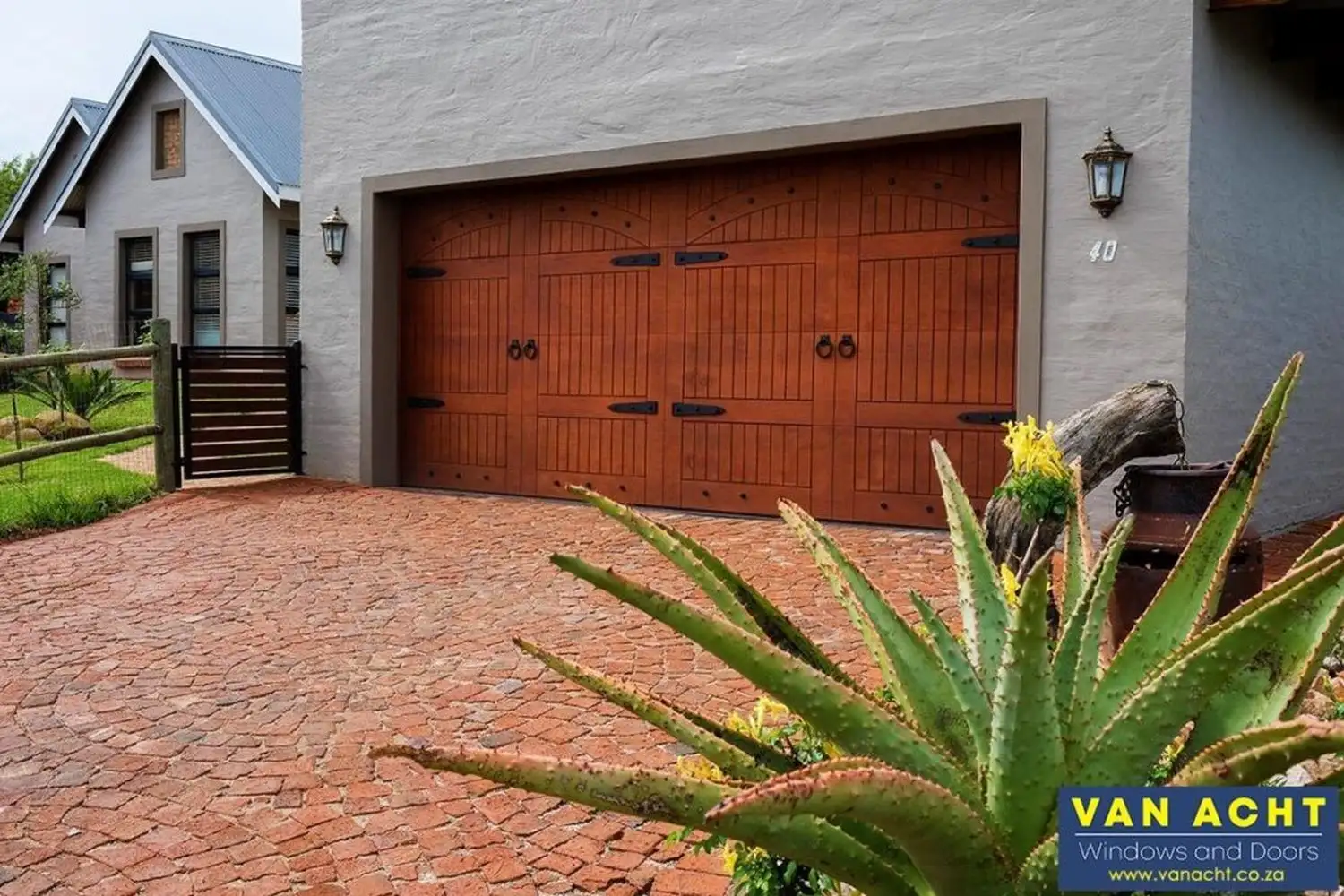
The leading cause of garage door problems is deferred maintenance on hardware rather than failure of the door itself. A consistent maintenance routine is simple and saves significant expense.
Hardware
- Lubricate springs, rollers, hinges, and tracks every six months using a silicone-based lubricant. Avoid grease, which attracts dust and grit.
- Inspect springs for wear or rust annually. Tension springs are under high load and should only be adjusted or replaced by a qualified technician — do not attempt this without the right experience and tools.
- Check that rollers move freely in the track. A door that sounds louder than usual or moves unevenly is often a hardware issue, not a motor issue.
Timber Doors
- Inspect the finish annually. Address any cracking, peeling, or UV greyness before it becomes a larger problem — refinishing is far less expensive than replacing a door that has been allowed to deteriorate.
- Pay particular attention to the bottom edge and any horizontal joints — moisture ingress typically begins at these points.
- In high-humidity environments, the finish schedule should be more frequent than for inland properties. The supplier or manufacturer of the door should be able to advise on the appropriate product and interval.
Steel and Aluminium Doors
- Wash the door surface periodically, particularly in coastal environments. Salt accumulation on unprotected surfaces accelerates corrosion.
- Inspect any areas where the powder coat or paint has chipped. Small chips on steel should be touched up promptly to prevent rust developing under the coating.
Choosing a Supplier
The supplier relationship matters more with garage doors than with many other home purchases. A door that is manufactured well but installed incorrectly will perform poorly. And a door that needs attention in three years is a problem if the supplier has no service capacity.
When evaluating suppliers, the things worth establishing upfront are: whether they manufacture or import, what their lead times are for custom orders, what after-sales service looks like, and whether they stock replacement hardware and parts for the doors they sell.
For buyers who want to see the range in person before committing — which is worth doing for any significant investment — Van Acht has showrooms across South Africa where the door range can be viewed and assessed directly.
Summary
The right garage door depends on a combination of factors specific to each property and each household. Before committing to a material or mechanism, it is worth working through the following:
- What mechanism suits the driveway layout and ceiling space?
- What material performs best in the local environment — coastal, inland, or Highveld?
- Is the garage attached to the living space? If so, insulation and security matter more.
- What is the realistic maintenance commitment? Timber rewards attention; steel and aluminium are more forgiving.
- Is the motor matched to the door weight and usage frequency? Is battery backup included?
- Does the supplier have service capacity after the sale?
A garage door that is well-matched to its environment, correctly installed, and maintained consistently will last twenty years or more. One that is not will require attention — and cost — long before that.