
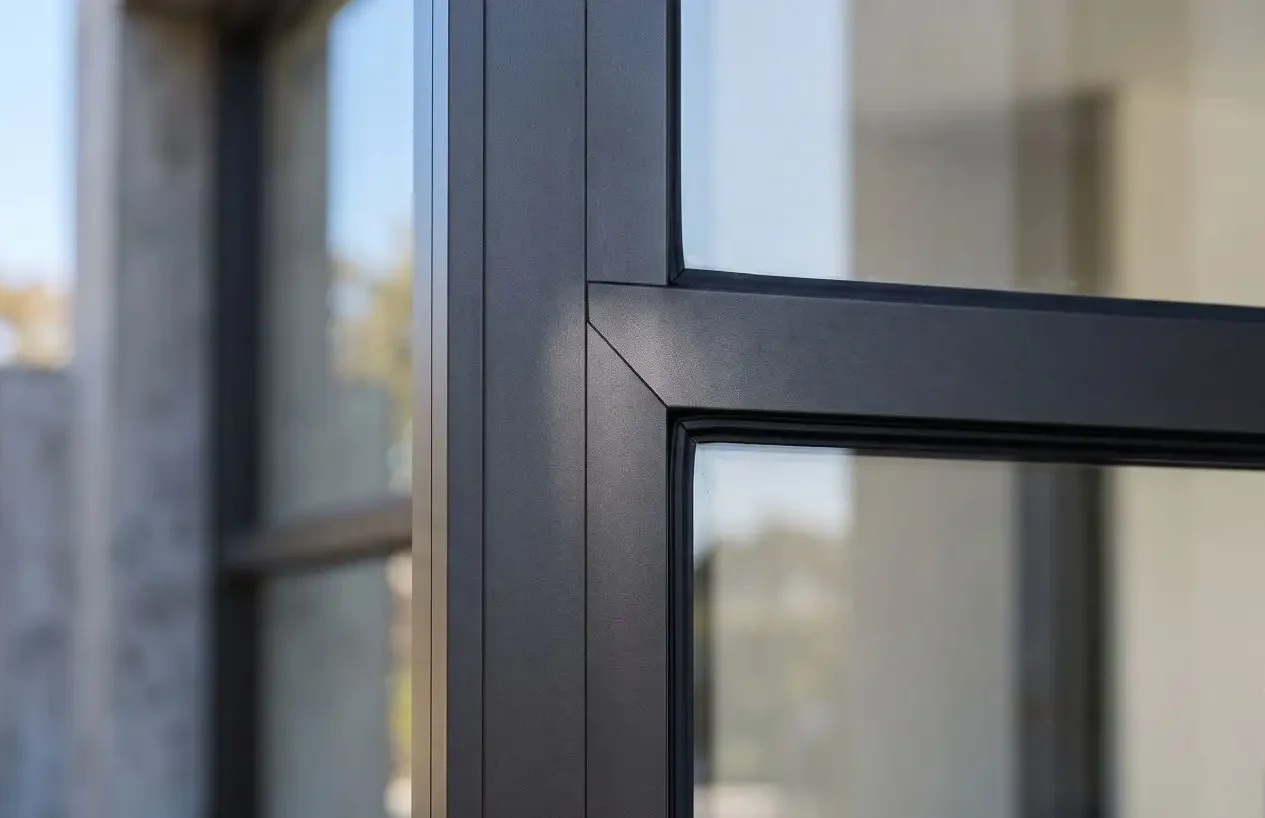
Ask why aluminium doors and windows don’t rust, and the honest answer is that they can’t — not in the way the word is usually used. Rust is a specific chemical reaction between iron and oxygen; aluminium contains no iron, so that reaction has nothing to work with. What aluminium does instead is a different process, one that happens to matter more than “rust resistance” in the loose sense most marketing copy uses it. That mechanism, and the equally underexplained reason a slim aluminium frame can carry a pane of glass a timber frame the same size can’t, are the two properties that decide most of what an aluminium door or window is actually capable of. Everything else — how it moves with heat, what happens to it at the end of a building’s life — follows from those two.
Why “Rust” Is the Wrong Word for What Aluminium Does
Rust is iron oxide, and unlike the reaction aluminium undergoes, it doesn’t self-limit: it forms as a loose, porous layer that flakes away and keeps exposing fresh iron underneath, which is exactly why steel construction is normally galvanised, painted, or otherwise coated rather than left bare — the coating is doing a job aluminium’s own oxide layer performs on its own. Aluminium reacts with oxygen too, but the result is a different compound, aluminium oxide, and it behaves nothing like rust. The reaction happens almost instantly — a fresh-cut edge starts forming its oxide layer within a fraction of a second of hitting the air — and the layer that results is a few nanometres thick, transparent, and bonded tightly enough to the metal beneath it that it doesn’t flake or lift. Once it’s formed, it seals the surface against further oxygen, and the reaction essentially stops itself.
That self-limiting behaviour is the actual mechanism behind “aluminium doesn’t rust,” and it’s also why a cut mitre or a drilled fixing hole in an aluminium frame doesn’t need special sealing at that specific point — the same oxide layer forms there too, on its own, the moment the cut is made. A powder-coated or anodised finish adds colour and a harder outer surface, but the base corrosion resistance was never coming from the finish alone; it’s a property of the metal itself.

Where Corrosion Resistance Actually Has Limits
None of that makes aluminium immune to every failure mode, and treating “won’t rust” as an unconditional guarantee is where specification actually goes wrong. Two real mechanisms can break through the oxide layer’s protection.
The first is galvanic corrosion. When aluminium sits in direct contact with a more noble metal — stainless steel is the common one, in fixings, hinges, or hardware — and moisture bridges the two, a small electric current flows between them, and the aluminium corrodes preferentially at the contact point far faster than it would on its own. This is the real reason hardware in contact with an aluminium frame needs either a compatible alloy or a deliberate isolation layer — a nylon washer, a compatible coating — rather than whatever fixing happened to be on hand. It’s a wiring problem as much as a materials one: break the electrical contact, or match the metals, and the reaction has nothing to run on.
The second is pitting corrosion under chloride exposure. Salt-laden air carries chloride ions that can locally break down the oxide layer faster than it re-forms, and because the attack concentrates at small points rather than spreading evenly, the result is pitting rather than the broad, gradual wear rust produces. It’s a real limit, not a dramatic one, which is why alloy choice and finish grade both get specified more carefully for a frame going into a humid, salt-exposed environment than one that isn’t.
Strength-to-Weight Ratio: Why a Slim Frame Still Carries Real Load
Aluminium’s density is about a third of steel’s — roughly 2.7 g/cm³ against steel’s 7.85 g/cm³. In absolute terms, steel is the stronger metal outright: common structural grades sit around 400–550 MPa in tensile strength, and some high-strength steel alloys exceed 2000 MPa — well past anything an aluminium extrusion reaches. What aluminium wins isn’t that contest; it’s the ratio. Pure aluminium starts soft, at around 90 MPa, but 6063 — the alloy most window and door extrusions are drawn from — heat-treated to a T5 or T6 temper, pushes that past 200 MPa at roughly a third of steel’s weight. A frame doesn’t need to out-muscle steel to carry its load; it needs enough strength at the lowest weight the opening allows, and that’s a different measure from strength alone.
The second lever is geometry, and it’s arguably the bigger one. Extrusion lets aluminium be drawn into hollow, multi-chambered cross-sections rather than a solid bar — internal ribs and walls positioned exactly where the load path needs them, material removed everywhere it doesn’t. Two profiles in the identical alloy can carry meaningfully different loads purely because one puts its wall thickness where the bending stress is highest and the other doesn’t. That combination — a genuinely strong alloy shaped into a section that puts material only where it’s structurally earning its place — is what lets a sightline stay slim while still carrying a large, heavy pane of glass. Nothing about the frame needs to be bulky for the opening to be safe; the strength was engineered into the shape, not added as extra mass.
Fatigue: What Happens After Tens of Thousands of Open-and-Close Cycles
A frame doesn’t carry its load once — it carries the same load repeatedly, every time the door or window it’s part of opens and closes, for as long as it’s in service. That repetition is what causes fatigue: a material weakening from cyclic stress even when any single cycle is well within what it could handle statically. Aluminium doesn’t have as clean a cut-off as steel, which can theoretically cycle forever below a certain stress and never fatigue at all — aluminium’s fatigue strength keeps declining slowly with every cycle, no matter how light the load. In practice, that decline is so gradual that a residential frame operates nowhere near the point where it becomes meaningful across a normal service life. Hinges, rollers, and locking hardware wear out from repeated mechanical use long before the extrusion itself shows any sign of cyclic fatigue — which is why hardware selection and lubrication do more for a door’s long-term feel than anything about the aluminium section it’s mounted in.
Thermal Conductivity: Where Aluminium Genuinely Gives Something Up
Metals conduct heat well for the same reason they conduct electricity well: the free electrons that move easily through a metal’s structure carry thermal energy along with them, transferring heat far faster than a material without that structure can. Aluminium sits at around 237 W/(m·K) on that scale — genuinely high, though not the highest of the common metals; copper, at roughly 401 W/(m·K), conducts even better, which is exactly why it’s the standard choice for wiring and heat sinks rather than aluminium. Wood sits at the opposite end entirely, typically somewhere around 0.1–0.2 W/(m·K) depending on species and grain direction, because it has no free electrons to move heat with — only the far slower vibration of its own molecular structure. That’s roughly a thousandfold difference, and it’s the one place aluminium doesn’t have an answer built into the raw material the way it does with corrosion or strength.
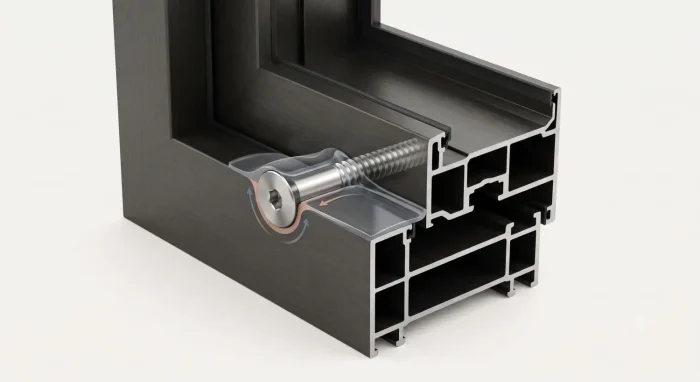
A thermal break doesn’t change that number — aluminium’s conductivity is a property of the metal itself, and no amount of engineering makes the metal conduct less. What a thermal break does is interrupt the path: a non-conductive strip, usually polyamide, physically separates the inner and outer faces of the profile, so heat has to detour through that low-conductivity material instead of travelling straight through solid metal from one side of the frame to the other. Done well, that cuts a frame’s overall heat transfer substantially — commonly somewhere in the range of half to two-thirds — enough to bring a well-specified thermally broken aluminium frame into roughly the same performance band as uPVC or timber, though the best timber and uPVC sections still typically edge it out. A thermal break manages aluminium’s conductivity, it doesn’t erase it, and the gap that’s left matters more in a climate with sustained heating or cooling demand than it does across most of South Africa.
Thermal Movement: Why Frames Need Room, Not Just Insulation
Thermal movement is a separate property from conductivity, and easy to confuse with it: it isn’t about heat passing through the frame, it’s about the frame itself physically changing size as its temperature changes. Aluminium does more of this than most of the materials it gets installed alongside — roughly twice the linear expansion per degree of an equivalent steel section, and considerably more than the glass sitting inside it.
That’s not a defect to design around apologetically; it’s a known, measurable input. Expansion joints, glazing bead tolerances, and the spacing left around fixings all account for a frame that’s a fraction of a millimetre longer on a hot afternoon than it was that morning. Where that movement isn’t planned for — a frame installed dead tight to an opening with no allowance, or a sealant joint sized for a static gap — is where doors start binding on hot days or a seal fails years before it should. The material isn’t misbehaving in that scenario; the installation didn’t leave it room to do what it always does.
Recyclability and What It Means for a Frame’s Practical Life
One property that rarely comes up next to rust resistance and strength, but genuinely belongs alongside them, is what happens to aluminium at the end of its use. It can be melted down and reprocessed into new stock without losing the structural properties that made it useful the first time — repeatedly, not just once. That doesn’t change how a frame performs on day one, but it changes what a frame represents over a building’s full life: material removed during a renovation or an eventual replacement isn’t a one-way trip to landfill, it’s raw stock for whatever gets extruded next.
Where These Properties Actually Show Up in a Finished Opening
None of this is abstract once it’s applied to an actual opening. A wide sliding or folding patio door leans hardest on strength-to-weight — it’s the property that lets the frame disappear behind the glass instead of dominating it. A frame going into a coastal or consistently humid position leans on getting the corrosion limits right — alloy and finish matched to the exposure, hardware isolated or alloy-matched, rather than assuming the base metal handles everything alone. A large glazed wall on the Highveld, where a dark frame can swing through a wide temperature range in a single day, leans on the installation respecting thermal movement rather than fighting it. Three different properties, three different reasons a given spec gets chosen — but all three trace back to what’s actually happening in the metal, not to a blanket assurance printed on a brochure.
Understanding the mechanism is what turns “aluminium doesn’t rust” from a marketing line into something a spec can actually be built on — which alloy, which finish, which fixings, how much room the frame needs to move. Matching those choices to the specific opening and its environment is standard practice in custom aluminium work generally, the same way measuring the actual opening is before anything gets manufactured — it’s what separates a frame that performs for its full service life from one that was simply assumed to.