
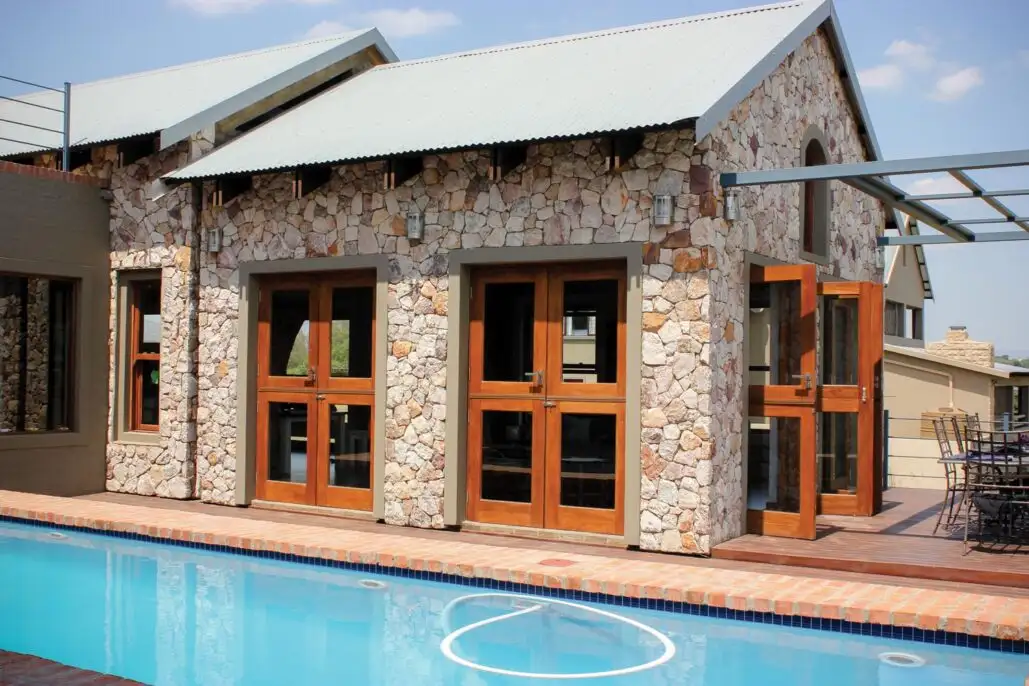
Timber’s reputation for needing constant attention comes down to one element doing all the work: the coating on top of it, not the wood underneath. Left bare, timber does move with humidity and fade under UV — but a door or window is never actually left bare. A finish is doing a specific, understood job from the day it’s applied, and “high maintenance” really means keeping that job done, not managing an unstable material. That distinction changes what maintenance actually looks like in practice: not constant vigilance, but a short list of checks on a schedule that runs shorter under Highveld sun than it does near the coast.
What a Finish Is Actually Protecting Against
Wood absorbs and releases moisture from the surrounding air as humidity and temperature shift through the day and across seasons. That movement isn’t even in every direction — a board swells and shrinks noticeably more across its width than along its length, which is why traditional joinery sets a wood panel to float loosely within its frame rather than gluing it rigid on all sides. The panel is free to move a few millimetres without the frame around it having to move with it. That’s normal behaviour for the material, not a defect, and it happens whether or not a finish is present.
What a finish adds is control over how fast that exchange happens, plus a second, separate job: shielding the wood’s surface from ultraviolet light. UV breaks down lignin, the compound that gives timber its natural colour, which is why an unprotected board greys and turns chalky within months of full sun exposure — a cosmetic change at first, but one that signals the surface fibres are starting to degrade. A finish slows moisture movement down to a manageable rate and blocks enough UV to keep that degradation from reaching the wood at all. Maintenance is the ongoing job of keeping that shield intact — nothing more exotic than that.
Why Clear Finishes and Paint Don’t Last the Same Length of Time
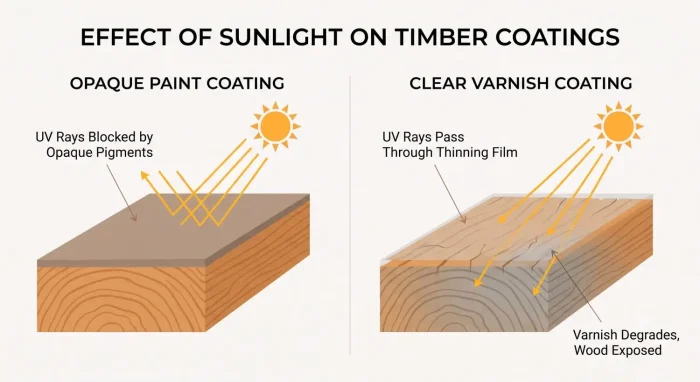
Pigmented finishes — paint, or an opaque stain — block UV directly: the pigment particles absorb and scatter the light before it reaches the wood fibres beneath. Clear varnishes and sealers don’t have that pigment layer to fall back on; they rely on UV-absorbing additives mixed into the coating itself, and those additives deplete with sun exposure over time rather than lasting indefinitely. That’s the real reason a clear-finished door needs recoating noticeably more often than a painted one on the same wall, facing the same sun — it isn’t a weaker product, it’s a different mechanism with a shorter working life built into it.
That trade-off is a genuine choice, not a mistake to avoid. A clear finish shows the timber’s grain, which is often exactly why it was chosen over paint in the first place — the shorter recoat cycle is the cost of keeping that look rather than a sign something was done wrong.
How Often, and What Changes With South African Climate
A yearly visual check covers most of what matters: look for chalking or fading on exposed faces, cracking or peeling at joints, and any gap opening up where a panel meets its frame. Beyond that inspection, the actual numbers differ by finish type and exposure. A clear or lightly tinted exterior finish under strong, consistent UV typically needs recoating every two to three years to keep ahead of that additive depletion; an opaque paint finish, protected by pigment rather than an additive that runs out, can usually go five to seven years before it needs the same attention.
Highveld exposure sits at the demanding end of that range — intense summer UV combined with wide day-to-night temperature swings is what wears a clear finish down fastest, so a west- or north-facing frame there is worth checking on the shorter end of the interval rather than the longer one. Coastal exposure changes the picture differently: salt-laden air doesn’t by itself shorten a coating’s UV life the way Highveld sun does, but it does mean rinsing accumulated salt residue off the surface periodically and keeping drainage and ventilation clear, since trapped moisture near the coast takes longer to evaporate off a surface once it’s there.
Species choice still does real work underneath all of this. A tropical hardwood like meranti resists the moisture side of coastal exposure on its own, and a denser hardwood like kiaat holds its shape through Highveld’s swings the same way — but neither removes the finish’s job entirely. Matching species to climate means the coating has less work to do and more margin if a recoat runs a little late, not that the coating becomes optional.
Does Engineered Timber Change the Schedule?
Engineered timber — built up from layered or laminated wood rather than a single solid section — is constructed with the grain direction of each layer controlled and often alternated, which cancels out much of the swelling and shrinking that would otherwise compound across a large solid section. That makes it a genuine option for oversized custom doors and windows, where a wide solid board would be more prone to warping or cupping over time.
What it doesn’t change is the finish schedule. UV and moisture act on whatever surface is exposed to them, and an engineered substrate presents the same surface to the sun as a solid one does. Choosing engineered timber can mean a more predictable door over the years — less risk of a large panel bowing or a wide stile twisting — but it isn’t a shortcut around recoating; that part of the job stays exactly the same.
What Skipping Maintenance Actually Costs
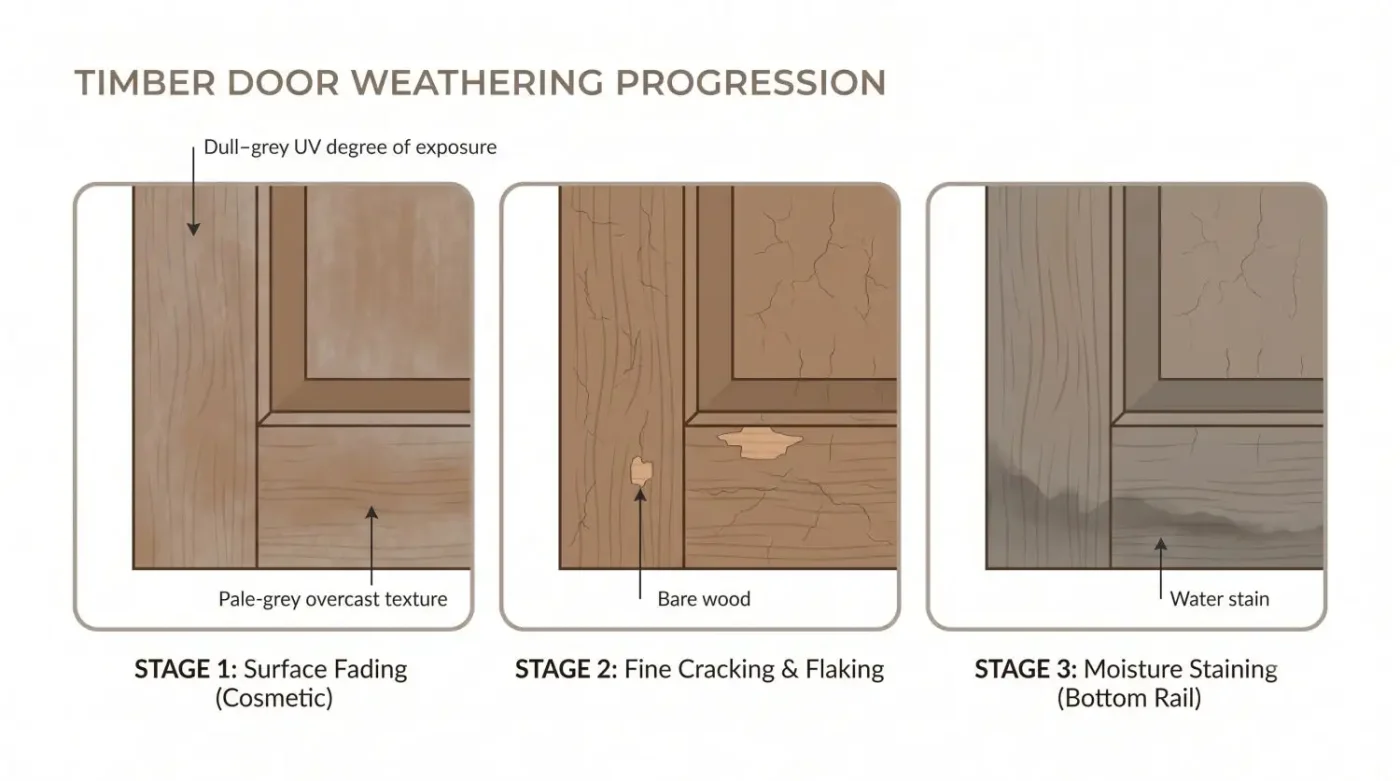
The honest failure sequence is slower than the “high maintenance” reputation suggests, and it’s worth knowing because it means most neglect is caught at the cheapest possible stage. The first sign is cosmetic: chalking, fading, a slightly rougher surface texture where UV has started breaking the coating down. At that stage nothing structural has happened yet — the wood underneath is still fully protected, just by a thinner margin than before.
Left further, the coating starts to crack and lift rather than just fade, and that’s the point where bare wood is genuinely exposed — usually first at end grain, at joints, and on a door’s bottom rail, where splash and any standing water collect most. Moisture reaching bare timber at one of those points raises the wood’s moisture content locally, and it’s only if that moisture content stays elevated for an extended period — typically because drainage is blocked or a sill is holding water rather than shedding it — that fungal decay becomes a real risk. Humidity in the air alone doesn’t get timber there; sustained standing moisture against bare wood does.
That sequence is also the reason catching a coating at the chalking stage is worth doing: recoating then is a surface job on a completely sound door. Waiting until the coating has already cracked and lifted still doesn’t usually mean structural damage, but it does mean more prep work — sanding back to bare wood at the failed spots — before a fresh coat goes on.
The Practical Upshot
None of this makes timber a material that demands constant attention — it makes timber a material where the attention it does need is predictable, scheduled, and almost entirely about a coating rather than the wood itself. Know the recoat interval for the finish that was chosen, check it once a year, and act at the first sign of chalking rather than waiting for something more visible. Matched to a climate-appropriate species from the outset, that’s the full extent of what a timber door or window asks for over its working life — a known task on a known schedule, not an open-ended commitment.