
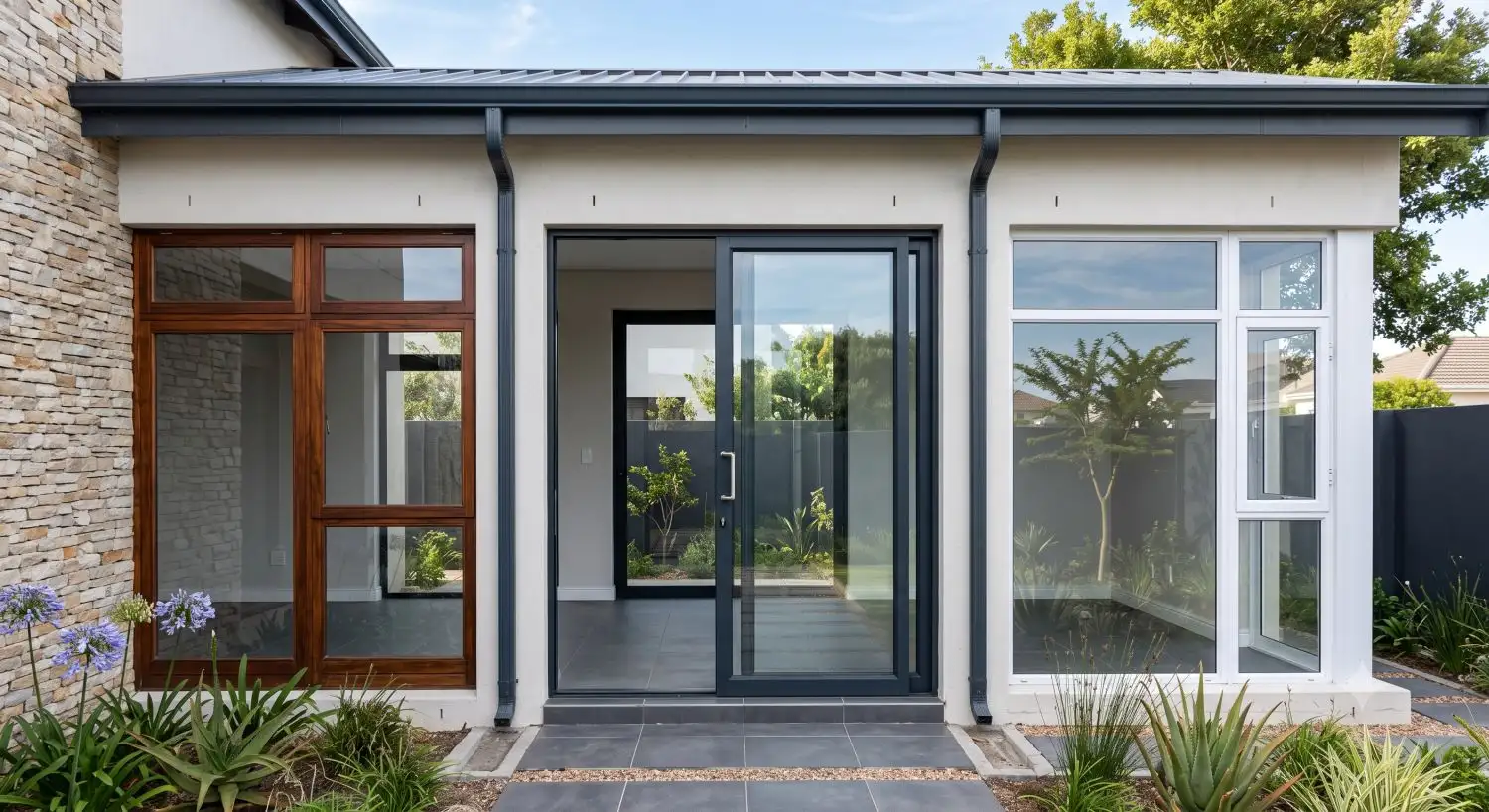
Search “best window frame material” and every result does the same thing: line up timber, aluminium, and uPVC, score them against each other, and name a winner. None of them ask what the winner is actually for. A frame material doesn’t perform in the abstract — it performs against a specific opening, in a specific climate, carrying a specific structural load. This covers what actually differs between the three, on the properties that matter for both doors and windows: strength, weight, weather resistance, energy performance, sound, and finish. Maintenance differs substantially between the three too, complex enough to be its own topic.
The Difference Starts With How Each Material Is Made
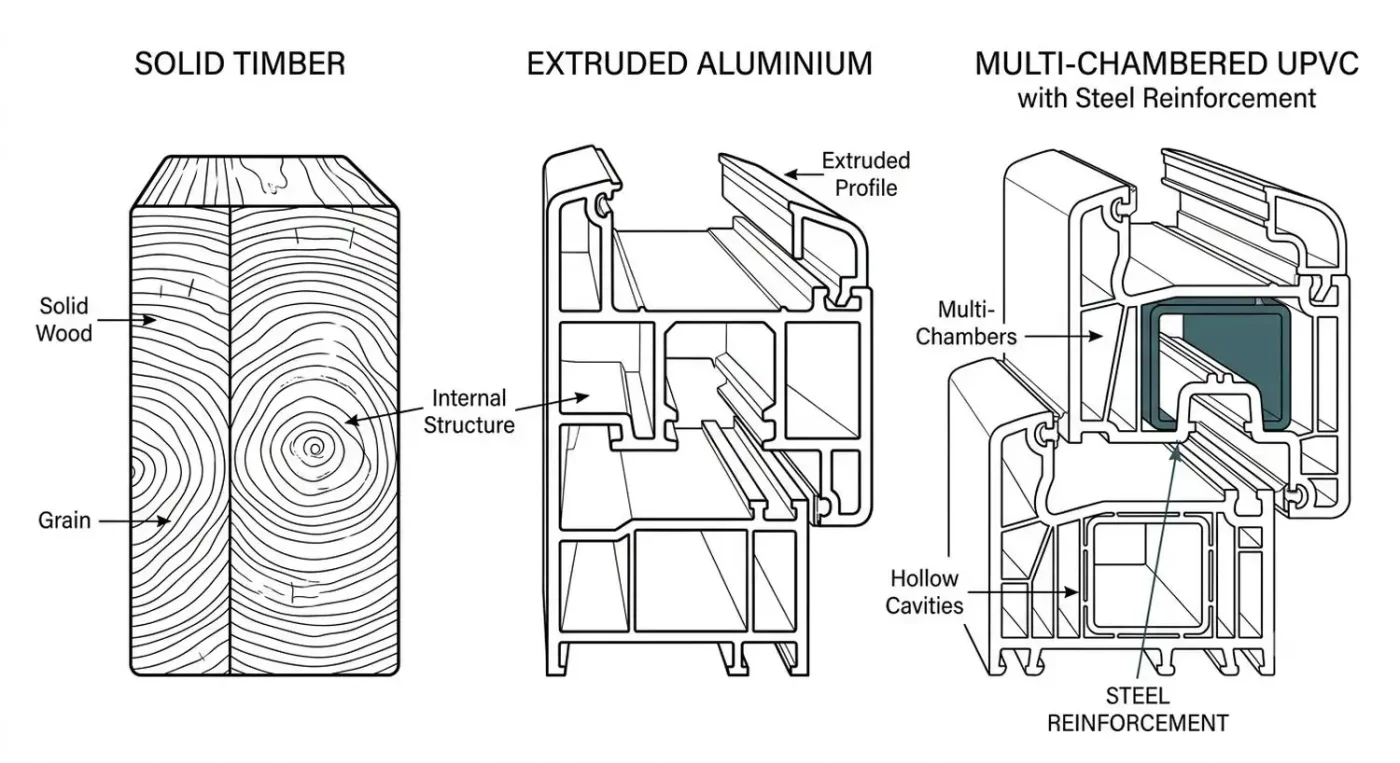
Timber is a solid, grown material — every board carries its species’ density, grain, and natural moisture behaviour. Aluminium is an extruded metal profile, drawn through a die to an exact cross-section, then cut and joined. uPVC is an extruded plastic profile too, but a hollow one — multiple internal chambers rather than a solid cross-section, with steel reinforcement added inside wherever a door or large window needs it.
That distinction isn’t academic. A solid material’s strength comes from its mass and grain; a chambered profile’s strength comes from its geometry and whatever reinforcement sits inside it; a metal profile’s strength comes from the alloy and the wall thickness of the extrusion. It’s why the three materials don’t fail, insulate, or age the same way — and it’s worth understanding before matching any of them to a specific door or window.
Strength and Weight
Weight and strength trade off differently for each material, and that trade-off is what actually decides what an opening can carry. Aluminium does the most with the least: an extruded profile carries real structural load without timber’s mass, letting it span larger openings and hold slimmer sightlines than an equivalent timber or uPVC frame the same size. Timber takes the opposite route, leaning into mass rather than avoiding it — a heavier species like kiaat holds its shape through Highveld swings largely because of that density, the same job aluminium does through engineering instead. uPVC goes further in the same direction again: it’s the lightest of the three, which is what makes it the easiest to handle and install, though it never catches aluminium’s load capacity at the largest sizes.
Each of those trade-offs shows up somewhere practical. Timber’s mass gives a locking system something substantial to engage into, but the same hardware then has to be rated for that mass specifically, or the door sags and drops over years of daily cycling. uPVC’s steel-reinforced profile carries a proper multi-point lock despite the lighter material, but its lower load capacity is part of why uPVC doors are specified for sliding and, in some configurations, folding openings rather than the hinged, pivot, or stacking doors where timber and aluminium take over — a restriction that doesn’t apply to uPVC windows, where the full range is available.

Weather Resistance
Each material resists South Africa’s climate extremes through a different mechanism, and no single one covers every angle. Aluminium comes closest to doing both at once: near the coast, a properly finished frame resists corrosion outright, though the hardware — pivot sets, hinges, handles — doesn’t share that immunity and needs its own corrosion-resistant finish specified separately; inland, the same heavier-section extrusion that gives aluminium its strength also resists the expansion and contraction that comes with surface temperatures well over 60°C on a dark Highveld frame in summer. uPVC resists moisture and rot outright too, in a simpler way — the material itself can’t absorb water the way timber can — but heat is where it needs care instead of climate broadly: a dark-coloured frame absorbs enough sun to expand measurably and stress its welded corners, where a lighter colour avoids that almost entirely. Timber depends the most on getting the specification right at the outset: a tropical hardwood like meranti resists coastal humidity much the way aluminium’s finish does, and a denser hardwood like kiaat holds its shape through Highveld swings the way aluminium’s mass does, just through density rather than engineering — but left unsealed or under-maintained, timber moves, cracks, or takes on moisture faster than either alternative, the clearest place it asks for more ongoing attention than the other two.
Thermal and Acoustic Performance
Timber and uPVC both manage heat and sound naturally, for related structural reasons, while aluminium needs engineering to catch up. Wood’s cellular structure traps air and resists heat transfer without any added design, and that same density dampens sound effectively — useful near a busy road or under a flight path. uPVC’s hollow, multi-chambered profile does similar work by a different mechanism, insulating and dampening sound before any additional engineering gets involved. Aluminium, by contrast, conducts heat roughly a thousand times more readily than either of them, so a bare profile transfers outside temperature straight through unless a thermal break — a non-conductive strip separating the inner and outer faces of the profile — interrupts that path; the same slimness that gives aluminium its strength-to-weight advantage also means its acoustic performance rests more on the glazing and seals specified alongside it than on the frame material itself.
Finish and Customisation
Timber and aluminium both stay adjustable after installation, just through different mechanisms, while uPVC is fixed from the start. Timber can be stained, painted, and refinished repeatedly over the life of the opening, so a scratch or a colour change doesn’t mean replacing anything — the attention it needs is attention it can actually use, restoring the surface rather than replacing it. Aluminium’s flexibility comes from powder coating instead — a dry paint applied electrostatically and oven-cured, available in a wide colour spread, holding for years with only the hardware needing separate attention near the coast. uPVC doesn’t share either kind of flexibility: colour is set at manufacture, in a foil-laminated or through-coloured finish, and isn’t repainted afterwards, and surface damage follows the same rule — a deep scratch or impact mark can’t be sanded or touched up, since the material itself would need replacing at that section rather than just its surface. That fixed finish is the trade-off for the low ongoing attention uPVC needs everywhere else.
Side by Side
The properties above translate into a quick reference:
| Timber | Aluminium | uPVC | |
|---|---|---|---|
| Structural basis | Solid, species-dependent | Extruded metal profile | Extruded, multi-chambered plastic |
| Strength and weight | Heaviest; density anchors hardware and locks | Best strength-to-weight; largest spans, slimmest sightlines | Lightest; easiest to handle and install |
| Weather resistance | Species-matched to climate; needs sealing/finish | Corrosion-resistant when finished; hardware needs separate attention | Won’t rot or rust; colour affects UV/heat performance |
| Thermal and acoustic | Strong naturally, no engineering needed | Needs a thermal break and considered glazing to match | Strong naturally, no engineering needed |
| Finish | Refinishable indefinitely (stain, paint) | Wide powder-coat colour range | Fixed at manufacture, not repainted or repaired |
| Door availability | Full range | Full range | Sliding, some folding — not hinged, pivot, or stacking |
Matching Material to the Opening
None of this produces a single winner, because the three materials are answering different questions. A large glazed opening built for a view leans toward aluminium’s strength-to-weight. A heritage façade, or a buyer who wants a frame that can be refinished rather than replaced, leans toward timber, with species chosen for the local climate. A high-volume development, a sliding opening, or a budget where minimal upkeep matters most leans toward uPVC. Coastal exposure works for either aluminium, via corrosion resistance, or a tropical hardwood like meranti, via its natural moisture tolerance — not exclusively one or the other.
Measuring the actual opening before finalising material and size is standard practice for custom door and window work generally, since dimensions, sun exposure, and structural load vary opening to opening even within the same house — quote-based ranges like Van Acht’s work this way for exactly that reason. That measurement is what turns the general match above into a specific one.
Timber, aluminium, and uPVC aren’t ranked against each other so much as suited to different jobs — the material chosen for one opening in a house can be entirely wrong for the next one a few metres away, and that’s normal rather than a compromise. Understanding what each is actually doing structurally is what makes the rest of the decision straightforward, whether that comes down to the opening’s exposure, its size, or simply how much ongoing attention it’s realistic to give it.