
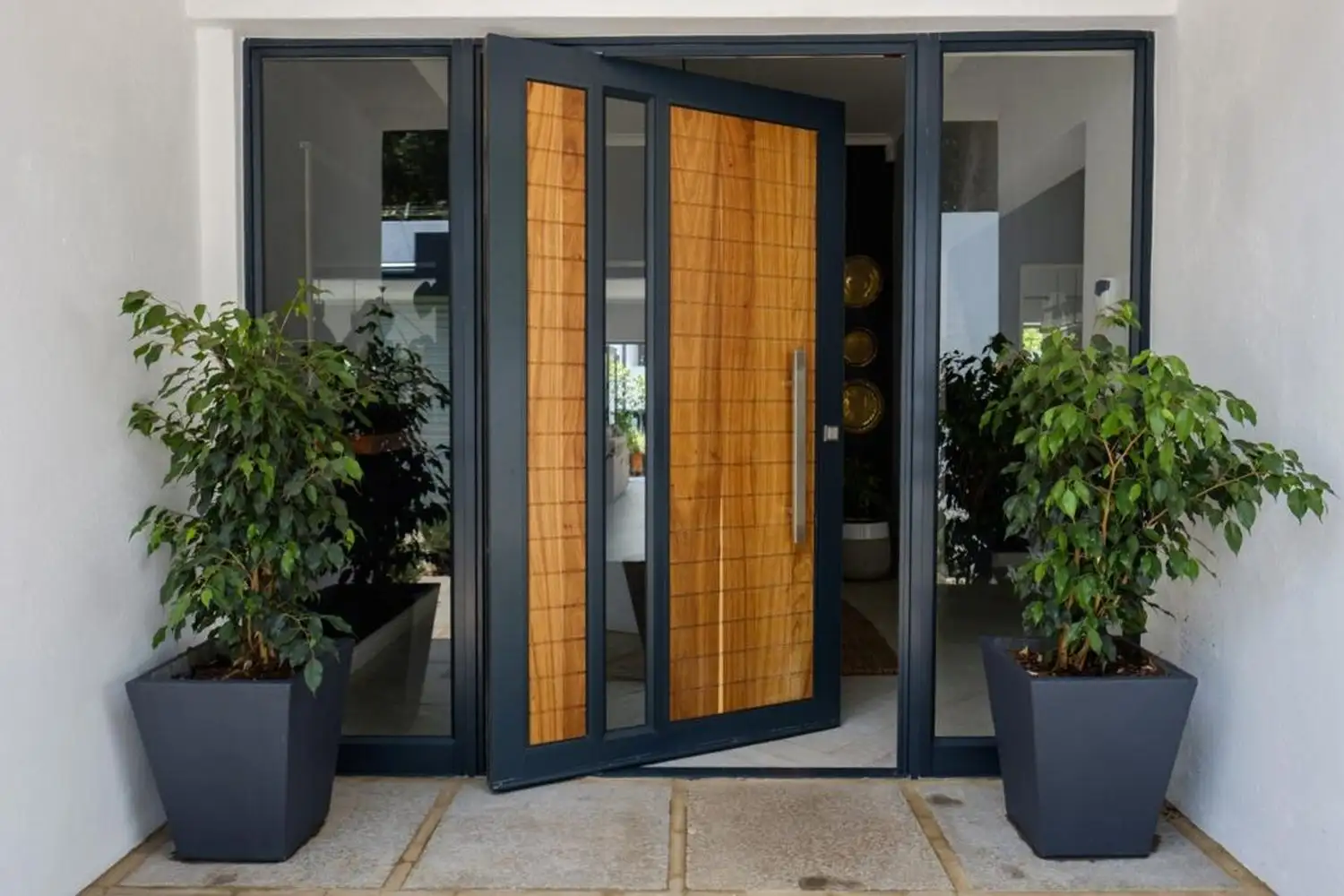
A hinge holds a door the way a bracket holds a shelf — the whole load runs along one fixed edge. A pivot door works more like a see-saw: the weight sits on a point near the centre, not the edge, and that point is what it swings on. It sounds like a small distinction until you put a 120kg solid timber slab in the opening. On hinges, that door pulls at its fixings and eventually drops at the leading corner. On a pivot, it doesn’t, because nothing along the edge is bearing the load in the first place.
That single mechanical difference is what this guide works through — what the pivot hardware actually has to do, which materials suit which entrance and climate, and how South African sizing conventions work.
Two Bearing Points, Not a Hinge Line
The hardware that makes this work is a bearing pivot set: an adjustable pivot near the top of the door and a floor or bottom pivot near the base, both set in from the corner rather than mounted on the edge. The top pivot is adjustable specifically so an installer can fine-tune the door’s height and alignment once it’s hung — the fitting a heavy door needs to swing cleanly instead of catching on the floor at one end of its arc.
This is a different piece of hardware from a bearing hinge, which is what a hinged door uses and which carries its load along an edge rather than at a single point. The two aren’t interchangeable, and it’s worth confirming which one a supplier actually means when hardware comes up in a quote.
What the pivot set has to handle changes with the door in front of it. A slim aluminium-framed glazed leaf can sit well under 40kg, where a solid meranti or kiaat panel at the same width easily passes 100kg — and the pivot set needs to be rated for whichever one it’s carrying, not a generic mid-range figure. Underspecify it on a heavy door and the failure looks the same as a worn hinge eventually would — dragging, uneven wear, a door that no longer closes flush — just concentrated at two points instead of spread along an edge.
The same two-point construction is also where a pivot door’s security advantage comes from. There’s no hinge line running down one edge for someone to work at from outside, since the door’s full weight sits on two enclosed bearing points rather than exposed hinge barrels. That advantage only holds if the lock matches it — handles and locks are specified separately from the door itself, as a keyhole escutcheon with either no lock or a 3-lever lock, or a cylinder escutcheon with no lock or a double-cylinder lock. A heavy, well-built door with whatever lock happened to ship with the handle is still only as secure as that lock, so it’s worth a deliberate decision rather than a default.
What the Material Has to Survive
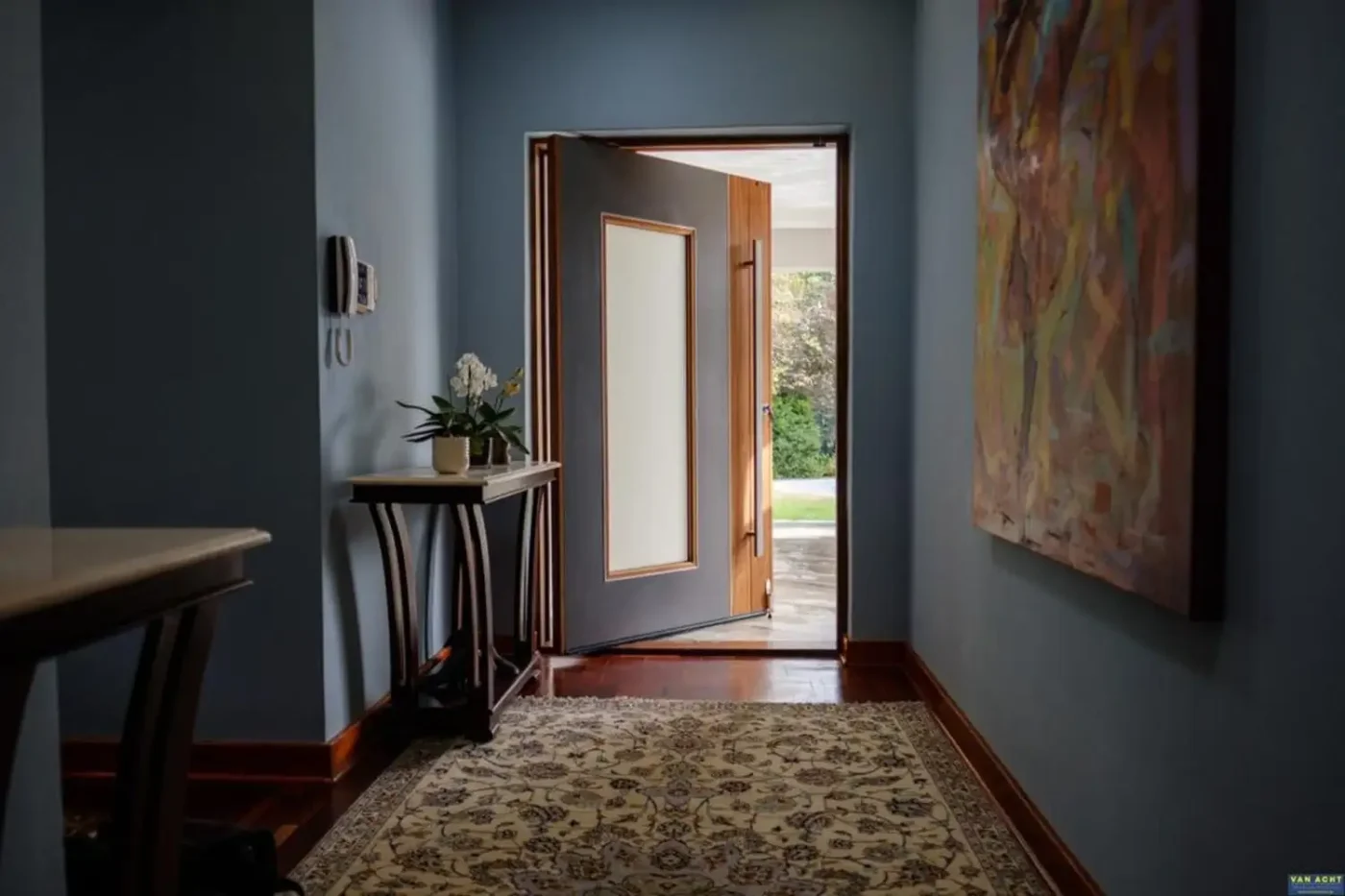
Meranti is the timber most pivot doors in South Africa are built from — a reddish-brown tropical hardwood that takes paint or stain well and carves cleanly, which is why the more decorative end of the range, from raised-and-fielded panelling through to fully carved designer doors, is almost always meranti. That tropical origin is also what makes it a genuine coastal option: properly finished, it resists the moisture and humidity that break less naturally resistant timbers down faster near the sea — provided the finish itself is renewed on schedule rather than left to weather away.
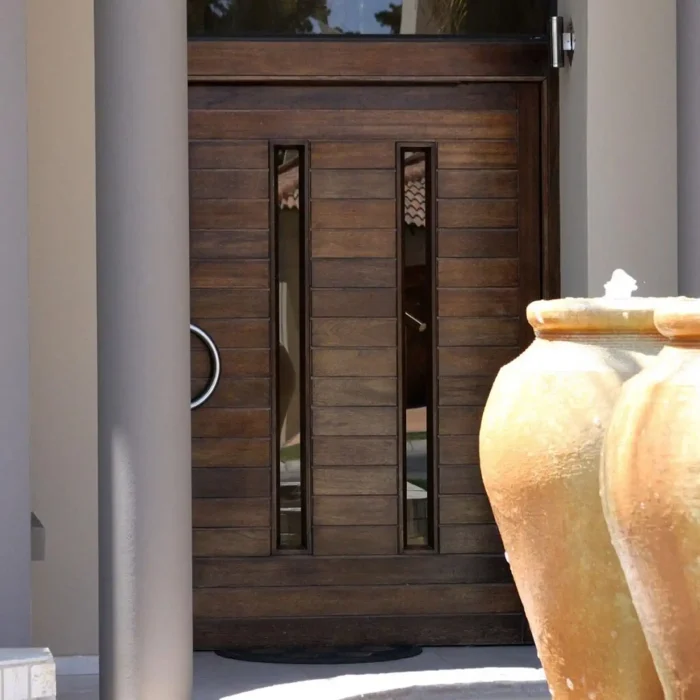
Marine ply is the answer for an entrance that takes even more punishment than that — built specifically to tolerate exterior exposure in a way standard meranti panelling isn’t, which is also why it asks for less frequent refinishing in the same harsh spot. It takes horizontal grooving, slatted detailing, and glass cut-outs well, which covers most of the contemporary timber-look designs on the market without moving away from timber at all. Kiaat, a denser hardwood, sits at the premium end of the same family — its density is what suits it to the Highveld rather than the coast, holding its shape through the big temperature and humidity swings of an inland summer more consistently than a lighter timber would, at the cost of being heavier in the hand and on the higher end of what the pivot set above has to be rated for.
Glass isn’t limited to the aluminium range, either. A meranti or marine ply door can carry a cut-out viewing panel or a full glazed section built into an otherwise solid timber leaf — lighter on the pivot set than a full aluminium-and-glass door of the same width, and a way to bring light into an entrance without moving away from timber altogether. A fully glazed design facing west also picks up real solar heat through a Highveld summer day, worth weighing against laminated or tinted glass at the design stage rather than after installation.
Aluminium is suited to both ends of the country’s climate range, for two different reasons. On the coast, it doesn’t corrode, so it earns its keep without a maintenance schedule attached — a wash now and then to clear salt build-up is the extent of it. Inland, the relevant property is dimensional stability rather than corrosion resistance: at larger custom sizes, a heavier-section extrusion resists the thermal expansion of a full Highveld summer — surface temperatures on a dark exterior frame can climb well past 60°C on a hot afternoon — more consistently than a lighter, cheaper profile does. It also suits a genuinely different look: a slim frame around a full glass pane, finished in champagne silver or gunmetal grey, reads as a contemporary entrance in a way a timber frame around the same glass doesn’t. A hybrid construction — an aluminium frame with a timber element built in, in the same two finishes — sits between the two: aluminium’s corrosion resistance and dimensional stability doing the structural work, with a timber detail keeping some warmth in the design. It costs more than solid timber at an equivalent size, which is the trade for asking less of you afterward. One detail worth specifying regardless of which material you land on: the bearing pivot set itself doesn’t share aluminium’s immunity to salt, so a corrosion-resistant finish on the pivot set and handles — satin chrome or stainless — is worth asking for on anything within a few kilometres of the coast.
Sizing the Opening — and What the Size Is Actually For
The standard South African pivot door, sold as the leaf alone for fitting into an existing frame, is 1200mm wide by 2032mm high. Bought prehung — door and frame together as one matched unit — the equivalent complete opening runs to roughly 1290mm by 2120mm, since the frame adds its own width and height around the leaf. A wider frame option exists up to around 1500mm for a larger single opening.
Prehung costs more than the door alone, but for a pivot mechanism specifically it removes a real source of on-site error: the two pivot points need to line up precisely with each other for the door to swing cleanly, and a factory-matched frame guarantees that alignment in a way an independently sourced door-and-frame pairing can’t promise. Confirm before ordering which side the handle sits on, too — pivot doors are supplied as left-hand or right-hand, fixed to which way the door swings, and getting that wrong against the entrance layout isn’t a small fix afterward.
This is also where the size question stops being just a dimension and becomes the reason pivot doors exist as a category at all. An architecturally deliberate entrance — wide, heavy, meant to be a feature rather than a functional gap in a wall — is exactly the scenario the pivot mechanism was built to solve, since a hinged door at the same width and weight is the one that eventually sags. Oversized and custom pivot doors are a routine request for that reason, though they carry a longer lead time and a heavier-rated pivot set — for an oversized aluminium frame, the extrusion quality noted above becomes the deciding factor at these larger dimensions. Measuring the opening on-site before manufacturing, rather than working from a tape measure alone, is standard practice for a custom pivot door — Van Acht does this for every custom order it takes on.
Choosing a Supplier
A pivot door is a more mechanically involved purchase than a standard hinged one, which makes the supplier relationship matter more rather than less. Worth establishing before ordering: whether the door and frame are manufactured and supplied as a matched prehung unit or expected to be sourced and fitted separately, and whether replacement pivot hardware is kept in stock for doors already sold — since a worn pivot set years later is a hardware problem, not a reason to replace the door.
Seeing the actual door in person before deciding is worth doing regardless of where it’s bought — a finish, a glazed panel’s proportions against the real opening, and the weight of a swing all read differently up close than they do in a photograph. Buying a door of this kind without seeing it first is not unlike buying clothes without trying them on, and a showroom visit is the straightforward way around that.
The door that holds up is the one where the pivot set was rated for the actual weight it carries, the material was matched to what the entrance faces, and the frame was measured rather than estimated. Every other decision in this guide — timber or aluminium, standard or custom, coastal finish or not — sits downstream of getting those three right.